Classification
- Class
- Reptilia
- Subclass
- Anapsida
- Order
- Cheloni
- Suborder
- Criptodira
- Family
- Cheloniidi
- Genus
- Chelonia
- Species
- Chelonia Mydas
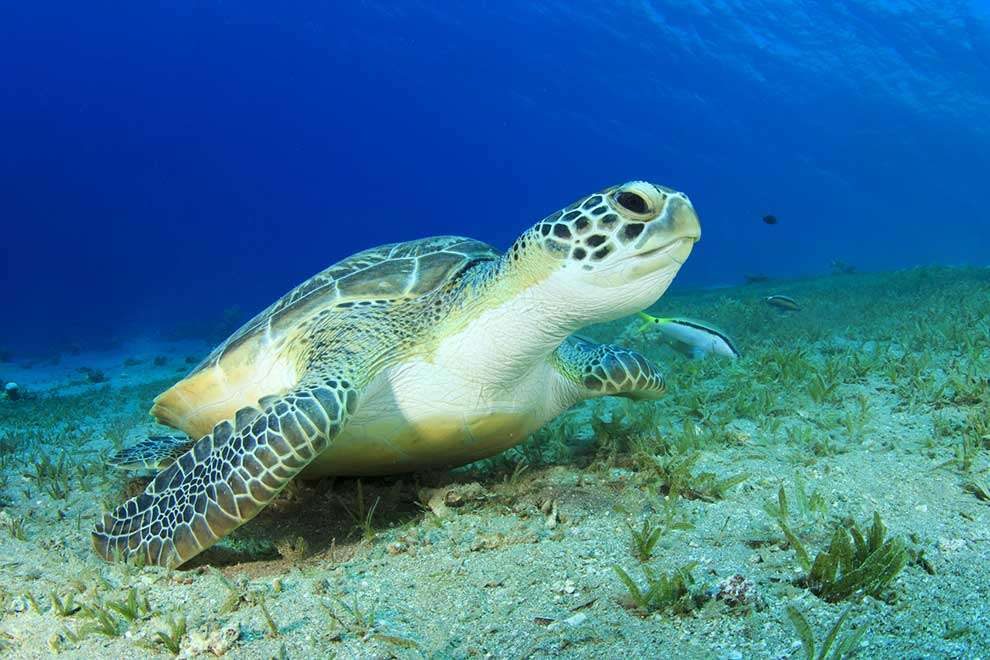
Chelonia mydas, also known as the green turtle, stands out from other sea turtles for its very smooth, polished carapace, which can measure up to 125 cm in length; the animal can weigh up to 250 kg. This feature is due to the arrangement of the horny scutes, which sit perfectly edge to edge. In this species there are 5 central or vertebral scutes, 4 pairs of costal scutes and 11 pairs of marginal scutes.
Its sturdy, bulky, rounded head bears a single pair of prefrontal scales, and the tip of the horny beak of the upper jaw is not hooked.
The male differs from the female in its sturdier (broader and longer) tail and its longer claws on the front flippers.
The shell is olive-brown, with yellow streaks and spots. Juveniles are a more uniform olive-brown, with yellow-edged flippers.
The species is found worldwide in tropical and subtropical seas. It lives in open-ocean and coastal waters, near coral reefs and sandy shores, from the surface down to 30–40 metres. It is present in the Mediterranean Sea. It differs from C. caretta above all in its impressive migrations of up to 2,000 km, which adults undertake in groups of thousands as they move from their feeding grounds to their mating and nesting areas.
It feeds mainly on seagrasses and algae, and its presence is betrayed by plant fragments, broken off by the animal, floating to the surface. Unlike the adults, the young are mainly carnivorous.
The breeding season runs from July to March. The female comes ashore at nightfall to lay her eggs; at this stage she must not be disturbed, as the slightest alarm is enough to send her back to sea or make her move to another nesting site. If all is calm, the turtle begins digging a cylindrical hole about twenty-five centimetres wide with her hind flippers, and starts laying her eggs in it. Once laying is complete, the animal gathers sand to cover the hole and then slowly returns to the water. The first clutch does not use up the supply of fertilised eggs in the female’s body: after some time the turtle returns to the chosen site to lay more eggs. The female appears to lay an average of 300–400 eggs per breeding season. This species comes ashore on its nesting beaches four or five times a year, at regular intervals of about a fortnight.