Classification
- Class
- Reptilia
- Subclass
- Anapsida
- Order
- Cheloni
- Suborder
- Criptodira
- Family
- Dermochelidae
- Genus
- Dermochelys
- Species
- Dermochelys Coriacea
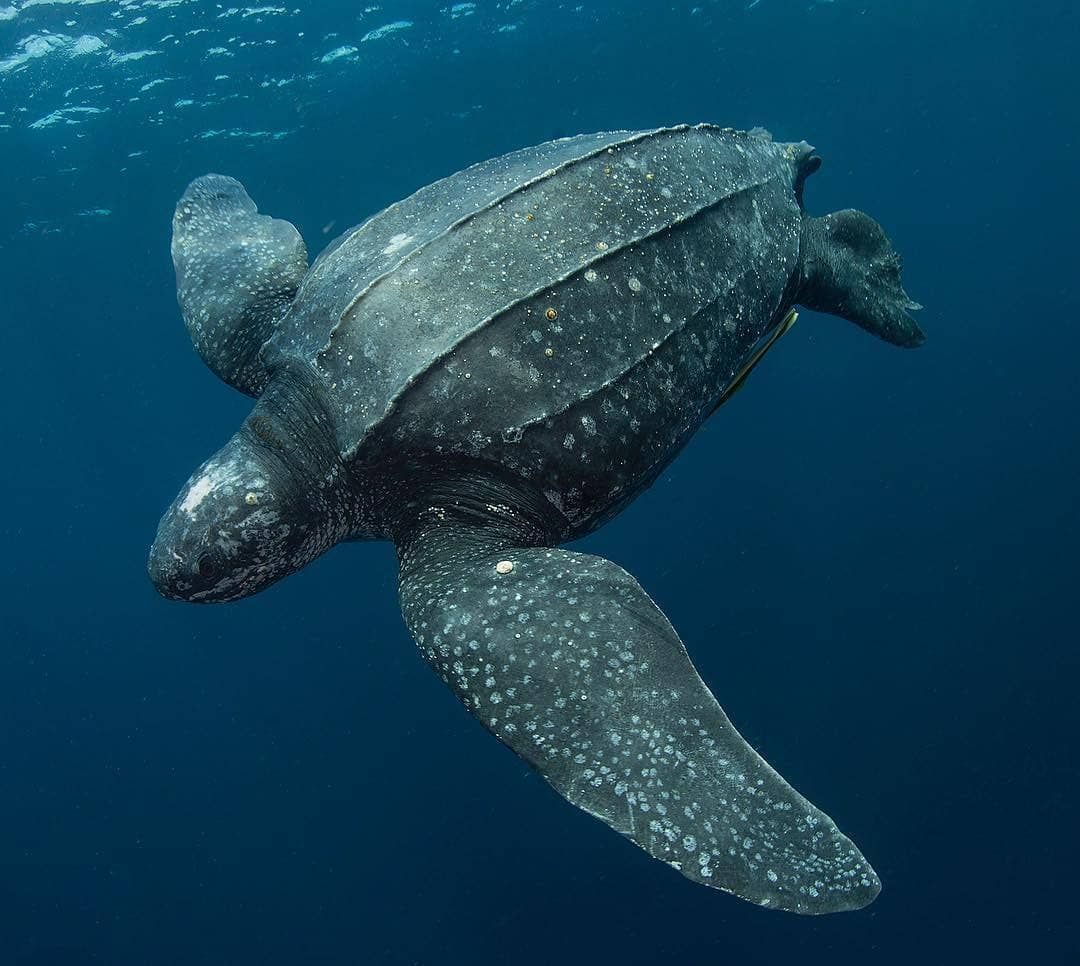
The Dermochelys coriacea, known as the leatherback turtle, is the largest of all sea turtles. It can reach 600 kg in weight and a carapace length of 2 m. Its carapace differs in structure from that of other turtles: instead of a bony shell it has skin with a leather-like texture, running along which are 7 longitudinal ridges, while the plastron is marked by 5 keels. In adults the front flippers are very long, reaching a span of two and a half metres. The carapace is dark in colour, with white spotting that is most evident in juveniles. In the male the plastron is concave and the tail reaches, and sometimes exceeds, the length of the hind flippers; in the female, by contrast, the plastron is convex and the tail is shorter than the limbs. It has a small, W-shaped horny beak.
Members of this species are adapted to living in colder waters than other sea turtle species. This ability is due to the protective layer covering their body, a thick, oily skin. In addition, the large size of this species helps retain the heat generated by muscle activity, which allows the animal to maintain a degree of "homeothermy".
As a result, the leatherback, although an Atlantic species, has a wide geographical range and is one of the most widely distributed of all turtles. Entering through the Strait of Gibraltar, the leatherback is thought to follow the warm-water currents that flow into the western and central Mediterranean; once it reaches the Strait of Sicily, the migration routes split at a precise point, one heading north (Italian and Corsican waters) and the other south (into Tunisian waters). Although it occasionally occurs in Italian waters, the capture of a leatherback is always a rare event that attracts great interest.
It is omnivorous, although it appears to prefer feeding on jellyfish. The upper jaw of its horny beak is fairly weak and suited to grasping only soft-bodied prey. Occasionally it also feeds on tunicates, squid, crustaceans, molluscs, fish, sea urchins and algae.
The leatherback has an egg-laying cycle of 2–3 years, and a female lays eggs 4–5 times per season, travelling long distances to return to the same nesting sites. The female usually digs a hole, up to 1 metre deep, in which she lays around a hundred eggs.
The hatchlings emerge after 50–90 days and weigh about 50 grams.
Under the criteria of the IUCN Red List (International Union for Conservation of Nature), the species is considered critically endangered. Its capture is prohibited even in countries that allow other turtles to be fished. Extremely sensitive to marine pollution, it is also threatened by swallowing floating plastic bags, which it mistakes for jellyfish, and by disturbance at its nesting sites. In 2013, following new population assessments, the IUCN lowered its extinction risk from critically endangered to vulnerable. The population is currently estimated at around 54,000 individuals, and it is projected that by 2040 it could rise to over 180,000.