Classification
- Class
- Reptilia
- Subclass
- Anapsida
- Order
- Testudines
- Family
- Cheloniidae
- Genus
- Caretta
- Species
- Caretta Caretta
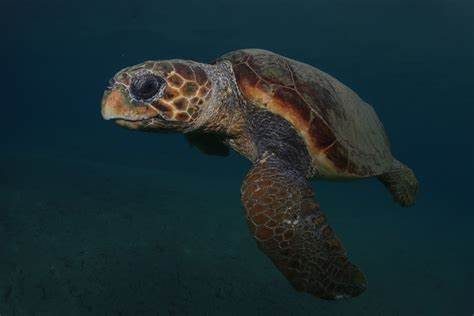
The Caretta caretta turtle is found in temperate and tropical seas and oceans throughout the world and is the most common sea turtle species in the Mediterranean Sea. At hatching it is about 5 cm long. An adult measures 80–140 cm in length and weighs between 100 and 160 kg.
The head is large, with a strongly curved beak known as the rhamphotheca. This is made of tough, sharp horny material, used for seizing prey and breaking the shells of the crustaceans on which the turtle sometimes feeds. The head bears two characteristic pairs of prefrontal scales, and near the eyes there are glands that remove excess salt taken in from seawater. The limbs are well developed, especially the front ones, and bear two claws in juveniles, reduced to one in adults. In water it can exceed 35 km/h, swimming nimbly with the characteristic synchronous stroke of its front flippers. The upper part of the carapace is made up of rows of horny scutes and is reddish-brown in adults, with darker streaks in juveniles. As shown in the drawing, there are 5 central or vertebral scutes, 5 pairs of costal scutes and 12 pairs of marginal scutes. Carapace size can be used to distinguish between age classes: hatchlings (10 cm), juveniles (10–40 cm), sub-adults (40–80 cm) and adults (over 80 cm). Young individuals also have a serrated keel along the vertebral scutes, which disappears as they grow. The underside of the “shell”, called the plastron, is heart-shaped and yellow with orange patches.
Males can be distinguished from females by their long tail, which develops when they reach sexual maturity at around 20 years of age. They are omnivores, feeding on molluscs, crustaceans, gastropods, echinoderms, fish, jellyfish, algae and aquatic plants. Unlike mammals and birds, reptiles cannot regulate their body temperature by internal means, so it depends on the temperature of their surroundings; for this reason they undertake long migrations of up to 5,000 km to escape cold winter waters, making use of ocean currents. They can hold their breath for long dives of about 1 hour, although a typical dive lasts 5–20 minutes.
Shortly before the breeding season (early summer), the male C. caretta migrates to the beaches where nesting will take place and waits offshore for the females. When the females arrive, the males begin courtship. Mating can last many hours, with the male holding on to the female with the claws of his front flippers. During this long period the male may be driven off by other males seeking to take his place; indeed, a single clutch often contains eggs fertilised by different males. During the breeding season the female alternates repeatedly between mating and egg-laying: she mates, goes ashore to lay her eggs and then returns to mate again, every 12–14 days throughout the season, producing between 2 and 5 nests. The incubation period depends on the temperature in the nest, which is influenced by weather conditions and by the position of the egg within the nest, and ranges from 45 to 70 days. As in many other reptiles, in C. caretta the sex of the hatchlings is determined by the external temperature, which varies from place to place. Lower temperatures tend to produce only males, while higher temperatures tend to produce only females. Each turtle nest contains 110–130 eggs.
Caretta caretta is listed on the IUCN Red List (International Union for Conservation of Nature) as a vulnerable species: VULNERABLE (VU); the Mediterranean subpopulation is assessed as Least Concern (LC).
There are several reasons: accidental capture of these turtles in fishing nets; the exploitation of adults and eggs as human food; and the destruction of their breeding habitats by humans, both through building and indirectly through noise pollution (boat noise disturbs them during nesting), chemical pollution (pesticides, petroleum products, etc.) and light pollution (city lights disorient hatchlings as they make their way to the sea). Global warming should not be overlooked either: by altering temperatures, it alters the sex of the hatchlings, causing serious imbalances in the population.
All this has led to C. caretta being protected by various international treaties and agreements.
These turtles are listed in Appendix I of CITES (Convention on International Trade in Endangered Species of Wild Fauna and Flora) as endangered species (Cheloniidae spp), for which all commercial trade is prohibited. They are also listed in Appendices I and II of the Convention on Migratory Species.