Classification
- Order
- Cetacea
- Suborder
- Odontocete
- Family
- Physeteridae
- Genus
- Physeter
- Species
- Physeter Macrocephalus
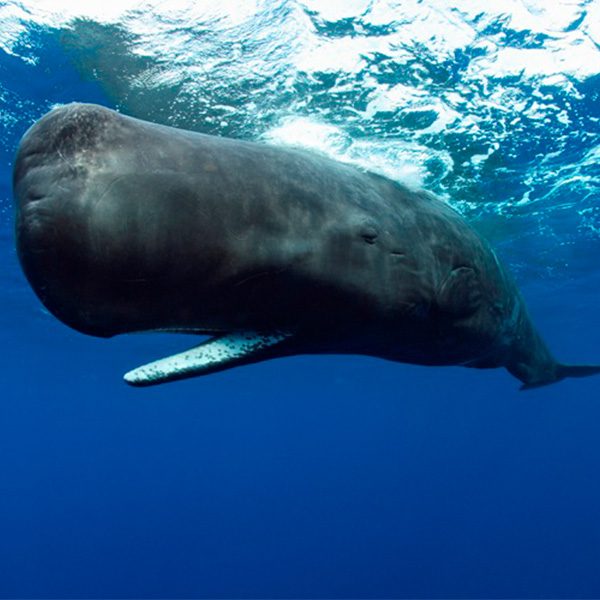
The sperm whale is widely distributed throughout the world's seas and is the largest odontocete (toothed whale) in the Mediterranean Sea; its enormous head accounts for one third of its body length. The lower jaw has an unmistakable shape: long, narrow and armed with 40-60 teeth, which are absent from the upper jaw. The body is dark grey, including the pectoral fins and tail; on the flanks this colouring becomes slightly paler, while the belly is white. Sometimes the lower part of the jaw and a small area of the head are white, as are small patches on the body surface caused by skin shedding. It has a small dorsal fin that looks very much like a hump, and between it and the tail fluke there is a variable number of knuckles. The pectoral fins are short and stubby. In older animals extensive white patches can be seen all over the body. It reaches 18 m in length and 50 tonnes in weight.
The short dives that precede the deep ones last about 15 minutes, with an undulating movement; the animal then takes in a large amount of air and strongly arches its back. A characteristic of its swimming is that it raises its tail out of the water before a dive. Deep dives can last up to 2 hours and take the animal down to 2000 m.
Sperm whales live in groups: a family group of about twenty individuals made up of females and their young, and another group of about forty individuals made up of adult males. In the family group, the young stay close to their mothers until they reach breeding age.
It feeds on cephalopods, giant squid and sometimes sharks.